The Womens Exponent Mormon Literature and Creative Arts Database
Mormon fiction is generally fiction by or virtually members of The Church of Jesus Christ of Latter-24-hour interval Saints (LDS Church), who are as well referred to every bit Latter-day Saints or Mormons. Its history is commonly divided into four sections as beginning organized past Eugene England: foundations, home literature, the "lost" generation, and faithful realism. During the beginning fifty years of the church'south beingness, 1830–1880, fiction was non popular, though Parley P. Pratt wrote a fictional Dialogue between Joseph Smith and the Devil. With the emergence of the novel and curt stories every bit pop reading material, Orson F. Whitney called on fellow members to write inspirational stories. During this "home literature" motility, church-published magazines published many didactic stories and Nephi Anderson wrote the novel Added Upon. The generation of writers subsequently the home literature movement produced fiction that was recognized nationally simply was seen as rebelling confronting home literature'southward outward moralization. Vardis Fisher's Children of God and Maurine Whipple's The Giant Joshua were prominent novels from this fourth dimension menstruation. In the 1970s and 1980s, authors started writing realistic fiction as faithful members of the LDS Church. Acclaimed examples include Levi S. Peterson's The Apostate and Linda Sillitoe's Sideways to the Sun. Habitation literature experienced a resurgence in popularity in the 1980s and 1990s when church-endemic Deseret Book started to publish more fiction, including Gerald Lund'south historical fiction series The Piece of work and the Glory and Jack Weyland's novels.
Latter-day Saint authors are well-represented in diverse literary genres. A tradition of befitting to conventions and building communities may explain why Mormon authors are successful in genre fiction. Glenn Beck, Jason F. Wright, and Richard Paul Evans have written inspirational fiction featured on New York Times bestseller lists. Orson Scott Card, Stephenie Meyer, and Brandon Sanderson are award-winning popular authors of science fiction and fantasy novels. Shannon Hale, James Dashner, and Ally Condie are popular authors of young adult science fiction and fantasy. The Association for Mormon Messages and LDStorymakers support their faith's authors with awards and conferences.
In that location have been some controversies over Mormon authors and their works. Brian Evenson resigned from his chore at Brigham Young University (BYU) afterwards controversy over his short story collection. In the by, Deseret Book has declined to sell books from pop authors because of their content. In 2013, Cedar Fort refused to sell a contracted book after 1 of the authors wanted to include a reference to his male partner in his author bio.
History [edit]
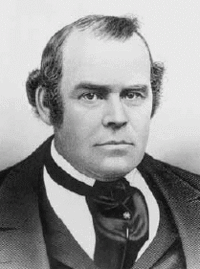
Mormon fiction's history begins at the same time equally the LDS Church. The history of LDS literature is generally divided into four periods, equally organized past Eugene England in his article on the subject.[1]
Foundations, 1830–1880 [edit]
Early written works amongst Mormons were by and large non-fiction, including scripture, missionary tracts, and doctrinal literature. In 1844, Parley P. Pratt published what is commonly cited as the kickoff work of LDS fiction, the didactic Dialogue between Joseph Smith and the Devil.[ii] Information technology was beginning published in the New York Herald. Early Mormon leaders similar Brigham Young and George Q. Cannon condemned novels for wasting time, a rhetoric that persisted until the 1880s.[1]
Abode literature, 1880–1930 [edit]
Fiction amid LDS Church members developed once the Mormons had settled in Utah and adult a degree of economical stability. In 1888, Orson F. Whitney called for an increase in "habitation literature," a "literature whose acme shall touch heaven."[3] : 173 He contributed his ain poetry to the efforts. In response to Whitney'south call, LDS periodicals published didactic stories.[1] [3] : 174 There was still resistance to the idea of reading fiction. In 1879, a church magazine chosen Contributor was started to encourage members to write. The tertiary issue condemned fiction as unhealthy for the mind and did not publish it in early bug.[three] : 174 Later on, in 1889, B. H. Roberts wrote an essay for Contributor on how fiction had increased in scope and popularity, and published his own historical short fiction, "A Story of Zarahemla," in the periodical that twelvemonth.[3] : 175, 177 Woman's Exponent, founded in 1872 and Immature Woman's Journal, starting in 1889, likewise published habitation literature. Relief Lodge Magazine started in 1915, with and entire department dedicated to "Arts and Literature."[3] : 177–178

The most successful work of LDS fiction in this period was the novel Added Upon (1898) past Nephi Anderson. Post-obit a human being and woman from their pre-earth life, through life on the earth and into the afterlife, Added Upon besides served as a model plot for after LDS fictional works, such every bit the 1970s musical Saturday'southward Warrior by Lex de Azevedo.[ane] Michael Austin noted in 1998 that Added Upon opened the door to fiction based on Mormon theology.[4] Josephine Spencer was another popular writer who Gean Clark called the "most versatile and expert" of early Mormon writers.[five] [half-dozen]
Brigham Immature'southward daughter, Susa Young Gates published a fairly successful novel, John Stevens' Courting (1909),[7] and B. H. Roberts wrote the novel Corianton, which Orestes Utah Bean plagiarized into a play and adapted into a movie.[8] The literary evolution in this catamenia stimulated the development of the first professional LDS publishing company in 1866. Originally independent of the church, George Q. Cannon and Sons is now part of Deseret Book.[ix]
The "lost" generation, 1930–1970 [edit]
While this "home literature" has connected to be produced ever since, a new generation of LDS writers arose in the mid century, i that was able to be published nationally and gain national recognition, but by and large at the expense of close ties to the Church and in rebellion against the moralism of "home literature," leading this generation to be called the "lost" generation.[ane]
Vardis Fisher was born in Idaho and his parents were Mormon; he joined the LDS Church briefly as an developed but did not place equally Mormon. Mormon characters are prominent in his early fiction. He won the Harper Prize in 1939 for Children of God (1939). Fisher's later fiction does not feature Mormon characters.[10] : 55 In a 1976 paper, Leonard Arrington and his student, John Haupt, renewed interest in Fisher's Mormon heritage, arguing that he did non completely reject Mormonism.[eleven] Fisher's widow subsequently issued a press release stating that Fisher was not Mormon. A 2014 Dialogue essay past Michael Austin concluded that Fisher was definitely influenced by the faith he rejected.[12]
"Historical-regional" novels were prevalent during this era, which Karl Keller called the "best fiction to come out of the Church" and criticized information technology as a byproduct of "a history and lifestyle that has already been created."[13] In this genre of "provincial" novels, Samuel W. Taylor wrote the humorous Heaven Knows Why (1948).[one] [14] Maurine Whipple won the Houghton Mifflin Literary Prize in 1938 and published The Giant Joshua (1941), which presented plural marriage equally a examination of faith similar to colonizing Utah's desert.[3] : 289 [10] In "Fifty Important Mormon Books," Curt Bench reported that Mormon scholars in 1990 unanimously chose The Giant Joshua every bit the best Mormon novel before 1980.[xv] Virginia Sorensen is best known for A Trivial Lower Than the Angels (1942), which too addressed the emotional hardship of polygamy,[3] : 292 and the acclaimed The Evening and the Morn (1949).[1] Her children'southward book, Miracles on Maple Loma (1957), won a Newbery Award.[10] Edward Geary wrote that Sorenson "peradventure realizes regionalist's ambiguity more than completely than any other".[16] : 97 Other notable writers from this period include Paul Bailey, Ardyth Kennelly Lorene Pearson, and Blanche Cannon.[13] [xvi] : 92–94 These "provincial" novels ofttimes feature a protagonist who belongs to her community, yet desires to leave. Another character, usually a man, is committed to community values and grows fanatical, opposing the protagonist. A third character, usually the child of the start two characters, leaves the community for a more individualistic life. Ofttimes a fourth character will accept on the function of "liberating Gentile," an outsider who tempts characters to leave their community or violate its norms.[16] : 92–94 In an assay of the "lost" generation, Terryl Givens notes that the novels from this era were "too compliant with the voices of criticism and cynicism to produce an art fully worthy of its subject."[3] : 297
True-blue Realism, 1960 to present [edit]
In the 1960s, Clinton F. Larsen adult verse in a faithful modernist manner, but information technology was not until the mid-1980s that novels emerged in this style.[1] Starting in the 1970s. BYU professors Douglas Thayer and Donald R. Marshall began to write skillful stories that explored Mormon thought and civilization in a critical just fundamentally affirmative fashion. Marshall published collections The Comb Sale: Collections and Recollections (1972) and Frost in the Orchard (1977). Thayer began publishing stories in BYU Studies and Dialogue in the mid-1960s, and published his collection of brusque stories, Under the Cottonwoods, in 1977.[1] In 1974, Karl Keller praised Thayer for using "concrete, worldly symbols" to articulate his faith, but stated that his piece of work did not go as far as creating a world where Mormon theology was "concretely true."[13] Keller called on authors to follow Flannery O'Conner'south example and let religion be "the light by which [they] see" rather than a substitute for seeing.[13]
Levi S. Peterson, influenced past Thayer,[1] wrote The Backslider (1986), which Terryl Givens called the "standard for the contemporary Mormon novel".[three] : 313 Common themes in Peterson's work are the conflict betwixt justice and mercy and between religious and secular thought.[ane] Eugene England hailed Linda Sillitoe's Sideways to the Sun (1987) equally "the first good Mormon novel about 1980s Mormon life in Utah."[17] It features a typical Mormon housewife whose husband disappears, leading her to form a new, more contained identity.[17] Also in 1987, Orson Scott Carte du jour published 7th Son, which England wrote "raises troubling questions about the supposedly sharp borderline between magic and faith."[17] : 175
The "true-blue realism" genre of LDS fiction refers to "challenging Mormon-themed fiction" written by Mormons for Mormons, and only represents a small part of LDS fiction.[10] : 57 Other writers in this genre include Margaret Blair Young, Phyllis Hairdresser, Marilyn Chocolate-brown, and John Bennion.[18] [10] : 57 Richard Cracroft called Douglas Thayer'due south The Tree Firm (2010) the "best LDS literary novel of recent decades."[xviii] The Mormon missionary novel, a common Mormon Bildungsroman, commonly falls under the faithful realism or modern home literature genre; Michael Fillerup'due south Beyond the River and Alan Mitchell'southward Angel of the Danube (2000) fall on the faithful realism side of the spectrum.[3] : 316–318 Faithful realist fiction has been anthologized by Levi Peterson in Greening Wheat: Fifteen Mormon Short Stories (1983), by Eugene England in Vivid Angels and Familiars (1992), by Angela Hallstrom in Dispensation (2010), and by Robert Raleigh in In Our Lovely Deseret (1998).[10] : 57–58 [iii] : 298 In 2017, the Mormon blog By Mutual Consent started the Past Common Consent Press, a volunteer, not-profit press.[19]
Mormon, or formerly Mormon, authors likewise write literary fiction for a general audience. Terry Tempest Williams'south Refuge is commonly anthologized and taught in college classes. Works by Walter Kirn and Judith Freeman appeal to non-Mormon audiences and deal with Mormon issues.[10] : 59
Mormon Folk Realism, 2000–present [edit]
Writing for Irreantum in 2000, Eric Eliason described Phyllis Barber'southward Parting the Veil as part of a Mormon magical realism movement in Mormon fiction, forth with works by Orson Scott Card and Levi Peterson. He stated that their work "allows for the reality of sacred experience and the possibility of bumping into beings of light.[20] : 43 In his dissertation on Mormon Literature, Scott Hales proposed a new type of Mormon literature that embraces ambivalence and is more concerned with the experience of Mormonism than its truth. It tends to blur genres and subvert expectations,[21] : 266 and includes a range of literary styles.[21] : 273 Hales attributes this shift to the way the LDS church building has inverse how it interacts with the public opinions of its members. In the early on 1990s, several intellectuals were excommunicated in connection with their ideas and criticism of the church. Later, when church members began voicing opinions online on social media and in the Mormon blogosphere, communal criticism and doctrinal speculation became more than common and unlikely to lead to ecclesiastical action.[21] : 267–270 The New Mormon Fiction provides a place for readers to "explore the cultural upheaval that surrounds them."[21] : 277 Hales and William Morris have since suggested that this type of literature be called "Mormon Folk Realism."[22] [23] Hales lists the work of several authors as falling under this category, including Arianne Cope's The Coming of Elijah (2006), Coke Newell's On the Road to Heaven (2007), Todd Robert Peterson'due south Family unit History (2007), Brady Udall's The Lone Polygamist (2010), and Steven L. Peck's The Scholar of Moab (2011).[21] : 272
Modern abode literature, 1980–present [edit]
Authors produced a new "home literature" of uplifting literature marketed to Mormon audiences and usually published by Deseret Book.[x] : 59 Popular authors in the 1980s included Jack Weyland and Blaine M. Yorgason. In the 1990s, Deseret Book, Bookcraft, and Covenant Communications, publishers targeting the LDS market, started selling more works of fiction. Other small publishers also started publishing fiction for the LDS market. Deseret Book published The Work and the Celebrity historical fiction series past Gerald Lund.[24] The popular nine-volume series sold over two million copies.[x] : 59 Dean Hughes is known for the series Children of the Promise set in World State of war II, and Hearts of the Fathers, which follows the aforementioned family into the 1960s. Tennis Shoes Amid the Nephites, a serial about people transported into scriptural times, was likewise published in the 1990s. Anita Stansfield'southward Mormon romance, Commencement Love and Forever (1994), sold over 40,000 copies and paved the way for similar novels,[25] such as those by Susan Evans McCloud, Rachel Nunes, and Jennie Hansen.[24]
In a 2010 essay examining how LDS fiction has changed since the 1990s, Jennie Hansen wrote that the writing improved over fourth dimension and LDS publishers stopped requiring an explicit LDS connection. Hansen also noted that some publishers cutting corners on editing and "do not ever adhere to LDS standards."[24] In 2006, Deseret Book stopped selling books to Seagull Book; Deseret Book's books accounted for about half of Seagull Volume's book sales.[26] Later that year, Deseret Book purchased Seagull Book and Covenant Communications, which greatly reduced Deseret Book'southward contest.[27] [28]
Genre fiction [edit]
LDS authors' success in genre fiction is peradventure considering, every bit Rosalynde Welch argues, "Mormon culture values superior performance of shared forms over the originality of invention."[29] She notes that the communities Mormons foster in their families and wards is duplicated in the way authors empathize genre communities.[29] Building on Welch'south piece of work, Jana Riess argues that LDS authors are skillful at conforming to genre expectations, and that the fashion they form and interact with their reading and writing communities contributes to their success.[xxx] At Times and Seasons, Nathaniel Givens states that Mormonism's lack of "official" theology or creeds leads members to a culture of "amateur theology." This culture leads to theories that brand good science fiction stories.[31]
In a New York Times article, Shannon Hale theorized that LDS authors are fatigued to genre fiction considering they prefer happy endings to bleak or tragic stories. Hale also noted that strong writing communities for LDS authors in children's and YA genres describe budding authors to those genres. In the same article, Rachel Nunes explained that since many LDS authors prefer not to include sexual content, they often write in the young adult genre, where avoiding sexual content is less conspicuous.[32] In response to these arguments, Leah Libresco points out that Ender'due south Game didn't shy away from violent content, and also that sexual content seems like a requirement for YA novels, with tamer books being relegated to the children'southward department.[33]
Inspirational fiction [edit]
LDS radio host Glenn Beck co-authored The Christmas Sweater, which was a number 1 New York Times bestseller in 2008. Jason F. Wright co-authored The Christmas Sweater with Beck; he too wrote The Midweek Messages and The Christmas Jars, both New York Times bestsellers. [34] [35] [36] Richard Paul Evans's The Christmas Box was a number one New York Times bestseller.[34] Evans has written 30 other novels in romance, action, and fantasy genres, and each novel spent some time on the New York Times bestseller list.[37] [38]
Scientific discipline fiction and fantasy [edit]

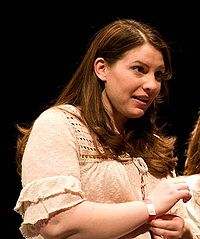
LDS authors are well-represented among successful scientific discipline fiction and fantasy authors. Orson Scott Carte was the commencement prominent LDS scientific discipline fiction writer.[39] He earned Hugo and Nebula Awards in 1986 and 1987 for his books Ender's Game and Speaker for the Dead.[1] Also in the 1980s, Tracy Hickman helped to develop the gaming fiction genre, writing adventure models connected to TSR's Advanced Dungeons and Dragons and co-authoring Dragonlance novels with Margaret Weis.[twoscore] Stephenie Meyer, known for writing the Twilight series, wrote The Host, which was a New York Times bestseller for over a year.[39] Brandon Sanderson, writer of epic fantasy, is another LDS writer of New York Times bestsellers, including The Stormlight Annal.[41] Sanderson has also written YA fantasy, including The Reckoners series of urban fantasy.[42] Zenna Henderson, popular in the 1960s for her stories about "The People," was raised in an LDS family.[39] According to Terryl Givens, science fiction works past Mormons commonly explore ideas "at the margins of conventional thinking," like life on other planets and apotheosis.[3] : 320 According to Preston Hunter at adherents.com, a quarter of novels that won Hugo or Nebula awards had an LDS author or references to Latter-twenty-four hour period Saints and Utah.[43]
Children's and YA fiction [edit]
In 2014, Utah had more than nationally recognized children's volume writers and illustrators per capita than any other state.[44] Rick Walton, a prolific author of children's books, helped to foster a community of children's book authors in Utah by leading critique groups and hosting a listserv for authors to meet and support each other.[45] The invitation-only group started as a listserv in 2001, and in 2014 held monthly meetings.[44] Walton, Carol Lynch Williams, and Cheri Earl planned the Writing and Illustrating for Young Readers annual briefing starting in 2000.[45]
LDS authors of immature adult novels often write in fantasy or science fiction genres. Shannon Unhurt won the 2006 Newbery Honor for her middle-grade fantasy novel Princess Academy. Brandon Mull, Aprilynne Freeway, Jessica Day George, and Kiersten White are likewise prominent writers of eye grade and YA fantasy.[39] [46] James Dashner and Ally Condie have written pop dystopian YA novels.[46] Robert Farrell Smith wrote the Leven Thumps series under the pseudonym Obert Skye.[18]
Associations and awards [edit]
In 1976, the Clan for Mormon Messages (AML) held its first annual symposium. The clan created an due east-mail forum, AML-list, in 1995, and a started the weblog "The Dawning of a Brighter Twenty-four hour period" in 2009.[x] The group has given annual awards since 1977.[47] The Mormon writers group, LDStorymakers, starting from a listserv made by Rachel Nunes, has held an annual conference since 2004. Robison Wells founded the Whitney Awards in 2007 equally an autonomous subsidiary of LDStorymakers.[48] [10] : 49–50 The science fiction and fantasy conference Life, the Universe, & Everything, held annually in Provo, Utah, often highlights LDS authors.[x] : 72 BYU publishes the student-run science fiction and fantasy magazine Leading Border.[iii] : 320
Starting in 1998, the AML began presenting an award to the best unpublished novel manuscript of the regional culture.[iii] : 273 In 2000 it inverse to the Marilyn Brownish Novel Award, administered by the UVU English Department,.[49] After 2011, the award was changed to a scholarship with a artistic writing component.[l] [51]
Controversies nearly LDS fiction [edit]
In the tardily 1970s, BYU Press declined to publish Nothing Very Important and Other Stories by Bela Petsco, because its content was "too controversial."[52]
While a new professor of creative writing at Brigham Young University (BYU), Brian Evenson published a short story collection, Altmann's Natural language, [53] a graduate student complained anonymously to church leaders that the piece of work promoted the "enjoyment" of violence, while Evenson argued that his fiction accentuated violence to show its horror and "thus allow information technology to be condemned."[53] A senior faculty fellow member brash Evanson not to publish similar works in the future.[54] Evenson resigned from BYU in 1995, and left the church building formally in 2000.[53]
Deseret Book has refused to sell books from successful LDS authors considering of implied infidelity,[55] premarital sex,[56] and offensive language.[57]
In 2013, Cedar Fort Publishing'due south banner, Sweetwater Books, deleted gay writer Michael Jensen's reference to his partner in his cover bio. Jensen requested that his bio reference his partner, and Lyle Mortimer threatened to publish the book without giving authors credit for their work. Afterward, Cedar Fort released the writers from their contract and did not publish the volume.[58] In response to Cedar Fort'southward determination, over forty Mormon authors signed a letter requesting that publishers make their publishing decisions based on a volume'southward content.[59]
Publishers specializing in the field [edit]
Presses issuing LDS fiction include:[threescore] [61]
- Covenant Communications
- Deseret Book
- Zarahemla Books
- Signature Books
- Cedar Fort press
- BCC Press
Run across also [edit]
- AML Awards and Whitney Awards, awards for LDS literature
- Association for Mormon Letters
- John D. Fitzgerald, for his The Groovy Brain series
- LDS Poetry
- Mormon literature
- Mormon Literature & Creative Arts, a Mormon works database
- A Motley Vision, an LDS criticism web log
Notes [edit]
- ^ a b c d due east f g h i j k l England, Eugene (1995). "Mormon Literature: Progress and Prospects". In Whittaker, David J. (ed.). Mormon Americana: A Guide to Sources and Collections in the United States. Provo, Utah: BYU Studies. ISBN0842523154.
- ^ Parley P. Pratt. Dialogue between Joseph Smith and the Devil Archived 2004-09-05 at the Wayback Machine. 1844.
- ^ a b c d east f g h i j thousand l m n Givens, Terryl C. (2007). People of paradox : a history of Mormon culture . New York: Oxford University Press. ISBN0195167112.
- ^ Austin, Michael (December 1998). "Critical Matters: Mormon Home Literature" (PDF). Sunstone . Retrieved 26 April 2018.
- ^ "Josephine Spencer". mormonarts.lib.byu.edu. Mormon Literature & Creative Arts Database. Retrieved 10 September 2018.
- ^ Turley, Kylie Nielson (2001). ""Untrumpeted and Unseen": Josephine Spencer, Mormon "Authoress"". Periodical of Mormon History. 27 (1): 149. Retrieved 10 September 2018.
- ^ Hales, Scott (12 Jan 2013). "Notes on Susa Immature Gates' John Stevens' Courtship". A Motley Vision.
- ^ Parshall, Ardis East. ""Corianton": Genealogy of a Mormon Phenomenon". Keepapitchinin, the Mormon History blog. Keepapitchinin.
- ^ "About - Deseret Book". Deseret Volume. Retrieved July 2, 2015.
- ^ a b c d e f g h i j one thousand 50 Austin, Michael (2015). "The Brief History and Perpetually Heady Future of Mormon Literary Studies" (PDF). Mormon Studies Review. 2 . Retrieved xxx Apr 2018.
- ^ Arrington, Leonard; Haupt, John (1977). "The Mormon Heritage of Vardis Fisher". BYU Studies. 18 (i): 28.
- ^ Austin, Michael (2014). "Vardis Fisher'south Mormon Scars: Mapping the Diaspora in the Testament of Human being" (PDF). Dialogue. 47 (3): iii, 18. Retrieved 30 April 2018.
- ^ a b c d Keller, Karl (Winter 1974). "The Example of Flannery O'Conner" (PDF). Dialogue. 9 (4). Retrieved 25 April 2018.
- ^ Bailey, S.P. (July 16, 2006). "Mormon Lit: Who Was Samuel W. Taylor?". A Motley Vision . Retrieved 2010-03-16 .
- ^ Bench, Curt (October 1990). "50 Important Mormon Books" (PDF). Sunstone.
- ^ a b c Geary, Edward A. (1977). "Mormondom's lost generation: the novelists of the 1940s". BYU Studies. 18 (one). Retrieved 30 April 2018.
- ^ a b c England, Eugene (1995). "Beyond "Jack Fiction": Recent Achievement in the Mormon Novel". In England, Eugene; Anderson, Lavina Fielding (eds.). Tending the garden: essays on Mormon literature. Common salt Lake City, Utah: Signature Books. ISBN1560850191.
- ^ a b c Cracroft, Richard (2011). "Literature, Mormon Writers of". The Encyclopedia of Mormonism.
- ^ Reiss, Jana (eleven Apr 2017). "New Mormon publishing house aims to 'achieve people who experience they don't take a place' - Religion News ServiceReligion News Service". religionnews.com . Retrieved 25 April 2018.
- ^ Eliason, Eric (Winter 1999–2000). "The "Mormon Magical Realism" of Phyllis Barber and Latter-solar day Saint Literary History". Irreantum. 1 (4).
{{cite journal}}: CS1 maint: date format (link) - ^ a b c d due east Hales, Scott (26 March 2014). Of Many Hearts and Many Minds: The Mormon Novel and the Mail-Utopian Challenge of Assimilation (dissertation). University of Cincinnati. Retrieved ix May 2018.
- ^ Hales, Scott (9 May 2018). "Scott Hales on Twitter". Twitter.
- ^ Morris, William (19 December 2008). "Wm". A Motley Vision . Retrieved nine May 2018.
- ^ a b c Hansen, Jennie (17 September 2010). "Where is LDS Fiction Going?". LDS Mag . Retrieved 23 Apr 2018.
- ^ Andrus, Elyssa (viii February 2003). "LDS novelists romance the fiction market". Daily Herald . Retrieved three May 2018.
- ^ "Seagull Book No Longer Allowed to Sell Deseret Book Products | KSL.com". 12 July 2006. Retrieved 25 April 2018.
- ^ "Deseret Volume Buys Seagull and Covenant Communications". KSL. 28 December 2006. Retrieved 25 April 2018.
- ^ Larsen, Kent (29 December 2006). "Bad Move, Deseret Volume!". A Motley Vision . Retrieved 25 April 2018.
- ^ a b Welch, Rosalynde. "Oxymormon: LDS Literary Fiction and the Trouble of Genre". www.patheos.com . Retrieved 23 April 2018.
- ^ Riess, Jana. "Mormon authors accept center stage with YA fiction - Faith News ServiceReligion News Service". religionnews.com . Retrieved 23 April 2018.
- ^ Givens, Nathaniel (29 April 2013). "Another Mail service about Mormons and Science Fiction". Times & Seasons . Retrieved 25 April 2018.
- ^ Oppenheimer, Mark (9 November 2010). "Mormons Offer Cautionary Lesson on Sunny Outlook vs. Literary Greatness". New York Times. Bookish OneFile. p. A15(L). Retrieved 23 Apr 2018.
- ^ Libresco, Leah (11 November 2013). "Mormons, Genre Fiction, and (No) Full Frontal Snogging". Unequally Yoked. Patheos. Retrieved 25 Apr 2018.
- ^ a b Boyd, Hal. "LDS authors who striking No.i on New York Times | Deseret News". DeseretNews.com . Retrieved 23 April 2018.
- ^ "Hardcover Fiction". The New York Times . Retrieved 2015-10-27 .
- ^ Mann, Court. "'Christmas Jars' author Jason Wright discusses new special edition of true stories". Daily Herald . Retrieved 23 April 2018.
- ^ "Richard Paul Evans". Simon & Schuster. Simon & Schuster.
- ^ "Richard Paul Evans Book List - FictionDB". world wide web.fictiondb.com. The Riviera Group. Retrieved 23 April 2018.
- ^ a b c d Morris, Katherine; Dalton-Woodbury, Kathleen (December 2010). ""Is It Something in the Water?" Why Mormons Write Science Fiction and Fantasy — Mormon Artist". mormonartist.net.
- ^ "Achievement Accolade Winners – The Whitney Awards". whitneyawards.com . Retrieved nine May 2018.
- ^ Jennings, Dana (16 April 2014). "After Years of Writing, an Author's Own Epic Fantasy Comes True". The New York Times . Retrieved ix May 2018.
- ^ "Brandon Sanderson's Steelheart Debuts at #ane on the New York Times Bestseller List". Tor.com. Tor. ii October 2013. Retrieved nine May 2018.
- ^ Hunter, Preston. Latter-24-hour interval Saint Demographics/LDS Statistics/ Mormon statistics. Archived from the original on September 1, 2000.
{{cite book}}: CS1 maint: unfit URL (link) - ^ a b Kirch, Claire (23 September 2014). "Utah'due south Children's Authors Build a Community". PublishersWeekly.com . Retrieved 25 April 2018.
- ^ a b Piper, Rachel (xiii January 2016). "Utah children's authors credit publishing nail not to Mormonism just to ane human being's insistence they never quit". The Table salt Lake Tribune . Retrieved 25 April 2018.
- ^ a b Jensen, Karen. "#FSYALit: Mormon Representation in YA Lit, a guest post by Sam Taylor — @TLT16 Teen Librarian Toolbox". www.teenlibrariantoolbox.com. Schoolhouse Library Journal. Retrieved 23 Apr 2018.
- ^ "AML Awards". Dawning of a Brighter Day. Association for Mormon Letters.
- ^ "About". ldstorymakers.com. LDStorymakers. Retrieved 3 May 2018.
- ^ "Archived copy". Archived from the original on 2011-09-20. Retrieved 2011-09-xvi .
{{cite web}}: CS1 maint: archived copy every bit title (link) - ^ "Marilyn & Neb Brown Endowed Writing Scholarship - Utah Valley University Scholarships". uvu.academicworks.com . Retrieved 16 April 2018.
- ^ "Scholarships". world wide web.uvu.edu. Utah Valley University.
- ^ Bergera, Gary James; Priddis, Ronald (1985). Brigham Immature University: A House of Organized religion. Salt Lake City, Utah: Signature Books. ISBN0-941214-34-half-dozen. OCLC 12963965.
{{cite volume}}: CS1 maint: engagement and year (link) - ^ a b c Young, Adrian Van (10 Feb 2016). "The Dark Fiction of an Ex-Mormon Writer". The New Yorker . Retrieved 25 April 2018.
- ^ Pratt, Linda Ray; Heywood, C. William. "Bookish Freedom and Tenure: Brigham Young University" (PDF). AAUP. Archived from the original (PDF) on xi September 2017.
- ^ Lythgoe, Dennis (14 November 2002). "Deseret Book says no to LDS author". DeseretNews.com . Retrieved 11 April 2018.
- ^ Nelson, Nick (one March 2004). "Stansfield'due south contempo volume rejected for explicitness - The Daily Universe". The Daily Universe . Retrieved 25 Apr 2018.
- ^ Fulton, Ben (x Dec 2010). "Deseret Book won't deport Utah author'southward latest novel". The Salt Lake Tribune . Retrieved 25 April 2018.
- ^ Piper, Matthew (22 August 2013). "Author says Utah publisher refused to include gay partner in bio". The Common salt Lake Tribune . Retrieved 25 Apr 2018.
- ^ Piper, Matthew (26 Baronial 2013). "Mormon authors dorsum gay writer in squabble with Cedar Fort". The Salt Lake Tribune . Retrieved 25 April 2018.
- ^ Wadley, Carma (2004-06-25). "Novel ideas". Deseret News. Retrieved 2017-09-25 .
- ^ "An industry that began more than 150 years ago, 'Mormon literature helps united states of america effigy out what information technology means to be Mormon' | LDS Guide 2017: The Mormon Marketplace". heraldextra.com. Retrieved 2017-09-25 .
External links [edit]
- MotleyVision.org, a group blog pertaining to peculiarly gimmicky LDS literature
- NewLDSFiction.com, links to fiction by LDS authors
whitehousemorgilizeed.blogspot.com
Source: https://en.wikipedia.org/wiki/Mormon_fiction
0 Response to "The Womens Exponent Mormon Literature and Creative Arts Database"
Post a Comment