Continue Statement Not Within a Loop Arduino
Break statement not within loop or switch
Break statement not within loop or switch
Break statement not within loop or switch en línea
break c examples
Imagine for example that you are doing a very long loop to find something in hundreds or thousands of places. But suppose that during the first few iterations you find the value you were looking for. Then it would not make sense to continue with the rest of the loop to search for that element, because you had already found it. In these situations it is useful to know for the loop to cancel the rest of iterations. Obviously, this is just an example of how we might need to control the loop a little more. In real life as a programmer you will find many other occasions where you will want to do this or other things with them.
So, there are two instructions that can be used in the different control structures and mainly in the loops, that will serve you to control two types of situations. They are the instructions break and continue:
This example, under normal conditions would count up to from i=0 to i=7, but each time the loop is executed it asks the user if he wants to increment the variable or not. If you enter «no», the continue statement is executed, so that you return to the beginning of the loop without incrementing the variable i by 1, since the statements below the continue would be ignored.
c# break for loop inside if
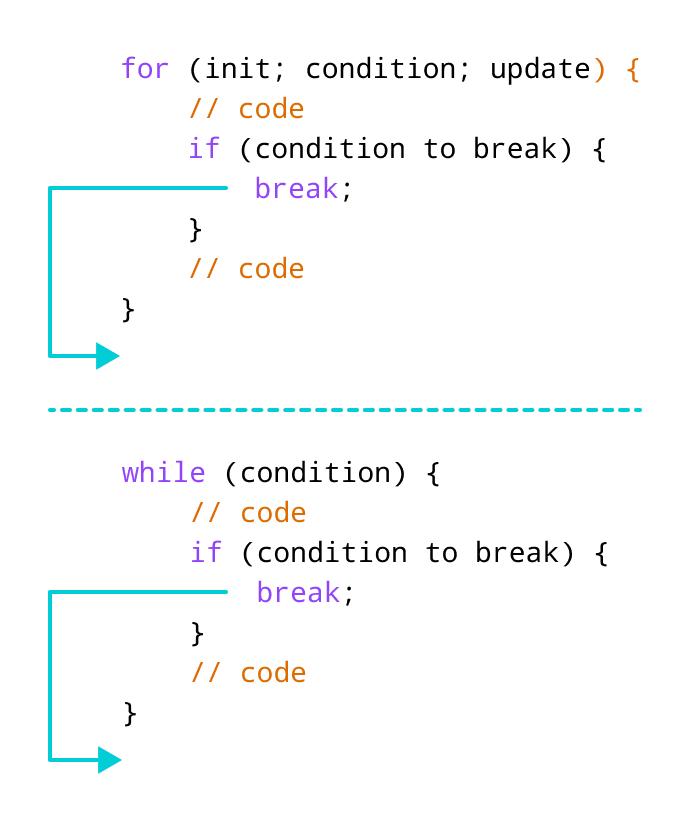
The forced exit of a while loop can be achieved with the use of the break statement; in the same way that we have indicated for for loops. When there is nesting of loops, the exit from the innermost loop to the next higher loop occurs. If a break; is written outside a loop or switch, the message «break statement not within loop or switch» appears.
In the first loop, we can see how, when the condition i>3 is checked, the loop is forced to exit. In the second loop, we see how when the remainder of dividing the index value by three results in zero, the execution of a code fragment controlled by a conditional is skipped. In this example, the values 0, 3, 6, 9 are not displayed because the remainder of their division by three is zero.
Transform the following pseudocode into code and reason to understand its logic. It is an example of implementation of ExitDo and Do … Repeat, which we must implement in C using the break statement; in a while loop with an always true input condition.
break c what is it for?
The Java programming language uses an object-oriented paradigm but also uses other paradigms such as the functional paradigm with the incorporation of lambas in Java 8 and the imperative paradigm in the blocks of method statements. In this article are the types of flow control statements available in the Java programming language: conditional, repetition, assignment, exception handling and method invocation in Java.
Java is an object-oriented language where by applying the principles of encapsulation, inheritance and polymorphism, the code is inside the methods of object classes. The code inside the methods follows the principles of imperative languages with a sequence of assignment, flow control, method call and repetition statements, more recently with the addition of lambdas and method references in Java 8 it is possible to employ a functional programming approach as well.
Imperative code is based on the sequential execution of a set of statements. The statements of a method or program are of different types: assignment, conditional, repetition, exception handling for error handling and function calls, in the case of object-oriented languages method calls. These individual statements can be nested inside each other, for example having a repetition statement inside the statement block of a conditional.
Relacionados
whitehousemorgilizeed.blogspot.com
Source: https://arduinoque.com/arduino/break-statement-not-within-loop-or-switch/
0 Response to "Continue Statement Not Within a Loop Arduino"
Post a Comment